Arguing with Algorithms in the Agora
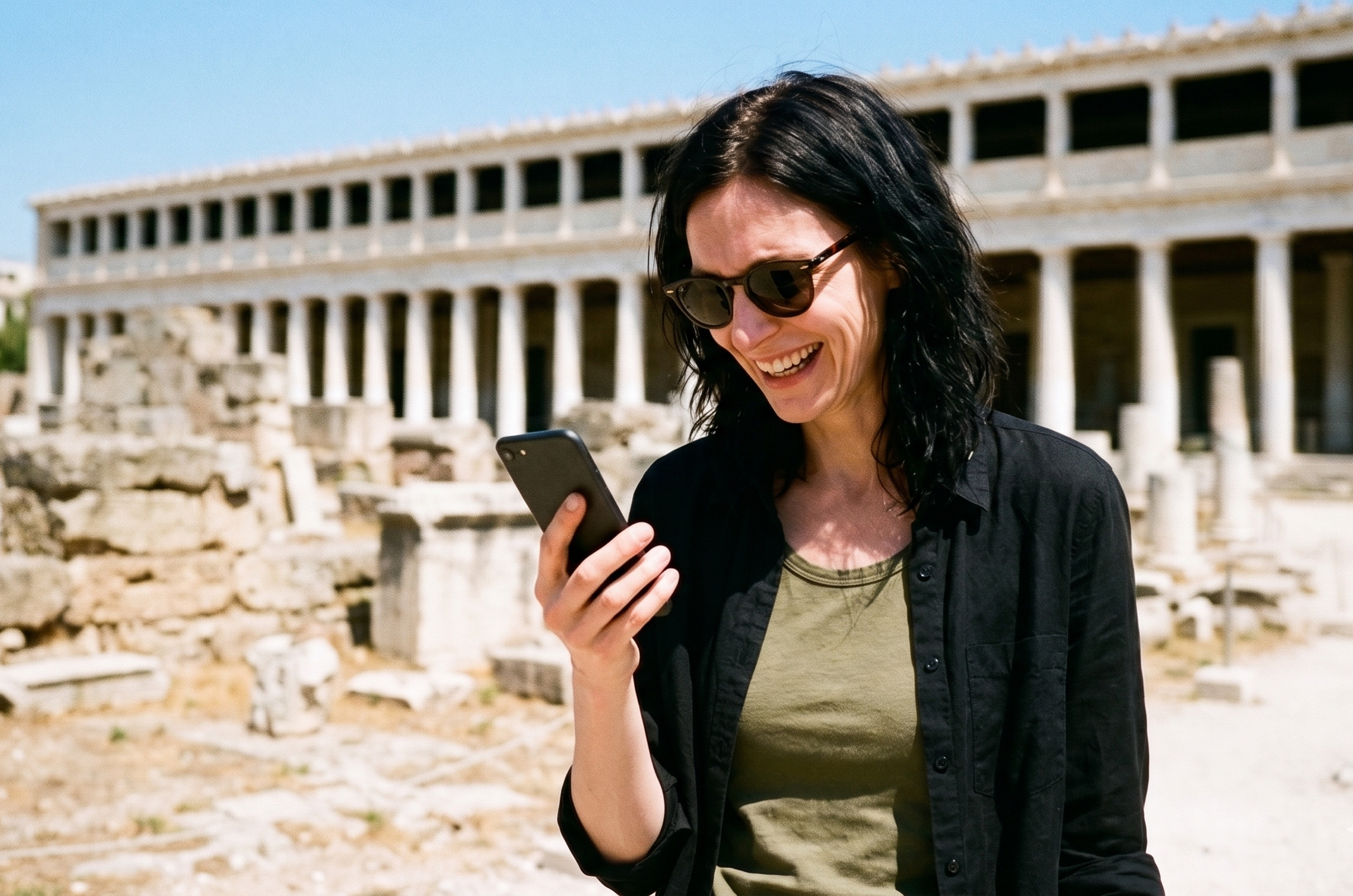
I got cocky.
After a solid week of practicing Halara—sitting in cafes, drinking iced coffee, and ignoring my screens—I felt incredibly enlightened. I felt like I had conquered my digital addiction. So, when I finally decided to go be a tourist and visit the Ancient Agora, I made a bold choice: I left my backup phone locked in my hostel room.
For the last decade, I have operated on a strict two-phone redundancy protocol. Leaving the second one behind felt like walking out the door without my shoes. But I wanted to prove to myself that I could exist in a historical space without needing an emergency digital exit.
The Ancient Agora is the beating heart of classical Athens. It’s where Socrates debated, where democracy was hammered out, and where Western philosophy basically grew its first legs.
I was doing great for the first hour. I was looking at the marble. I was feeling the history.
And then my brain got snagged on a thought about determinism and Stoicism, leftovers from my time in Lisbon. I couldn't quite remember how Epictetus framed the concept of "control."
Instead of just sitting on a rock and pondering it like a normal, enlightened person, I pulled out my phone and opened my AI assistant app. I figured I’d just ask one quick question.
Forty-five minutes later, I was standing in the shadow of the Stoa of Attalos—the exact ground where ancient philosophers literally invented the Socratic method—furiously typing out a massive counter-argument to a Large Language Model about the illusion of free will.
The irony is thick enough to choke on. For years, my job in Bellevue was clicking on traffic lights to train these algorithms. Now, I was standing in the cradle of human intellect, ignoring the 2,500-year-old ruins around me because I was hyper-focused on debating an algorithm I probably helped build.
I only stopped because the screen suddenly went black.
Running an AI chat app in the blazing Mediterranean sun with the screen brightness turned up to maximum had completely vaporized my battery. It went from 60% to dead in under an hour.
I was stranded in the middle of a massive archaeological site in central Athens with no map, no translation app, and no backup phone. My initial reflex was pure, unadulterated panic. My manager was dead.
But then... I just looked up. The Acropolis is a pretty good landmark. It’s literally a giant rock in the sky. You just walk away from it to get to the metro.
I navigated my way back to the Monastiraki station using nothing but street signs, spatial memory, and basic logic. It took me a little longer, and I accidentally walked through a very loud meat market, but I didn't die. The world kept spinning.
On my way back to the hostel, I passed an electronics kiosk. I could have just gone back to my room and grabbed my backup phone, reverting right back to my old two-device anxiety loop.
Instead, I bought a portable battery brick and a short charging cable.
A backup phone is an escape hatch. It’s paranoia. A backup battery is just good logistics. It means I'm staying in the world, I'm just making sure I don't get entirely stranded while I argue with robots.
I am officially a one-phone woman.
Current Status: Recharging. Both me and the device.