The Glitch in the Granite (Or: A Database Built with Blisters)
There are over 3,000 standing stones at Carnac.
When you first walk up to the low wire fences that protect the site, your brain physically struggles to process the scale. They don't just sit in a random cluster like a ruined building; they are arranged in perfectly parallel, receding lines that march across the French countryside for miles.
It is an architectural triumph. It is also deeply, undeniably rigid.
Standing there looking down the rows, I felt a familiar, cold hum in the back of my skull. It looked exactly like a server farm.
For years in Bellevue, I spent my days inside massive databases, counting, categorizing, and training systems to recognize patterns. Looking at Carnac, I felt my brain automatically trying to do the same thing: counting the columns, estimating the spacing, trying to decode the algorithm of the grid. Lenore thinks this place is an energy vortex. I think it’s a Neolithic hard drive. Whoever built this six thousand years ago was trying to record something massive—astronomy, seasons, tides—and they wrote the code in granite.
I actually respect the hell out of that. It takes a terrifying amount of discipline to build a system this big.
But I also realized that if I only looked down the rows, I was just treating it like data entry again. I was seeing the spreadsheet, but ignoring the cells.
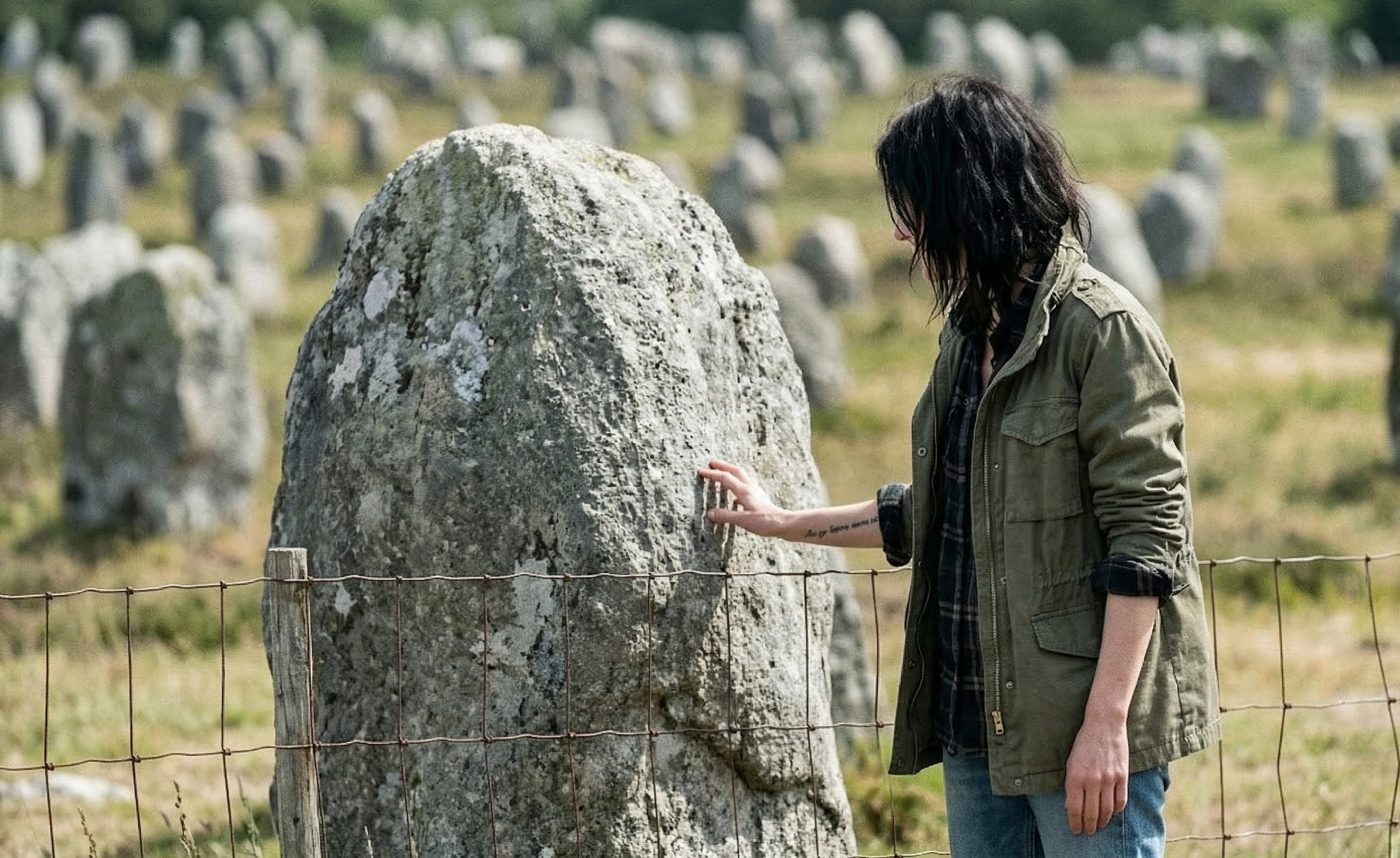
So, I stopped looking at the horizon and walked right up to the perimeter fence. I forced myself to focus on just one stone.
Up close, the "data" falls apart. The stone isn't a perfect cylinder. It’s jagged, heavily weathered, and covered in bright yellow Xanthoria parietina lichen. It’s heavy. It’s grounded. I touched the rough edge of it and thought about the sheer, agonizing friction required to move it.
The people who built this didn't have heavy machinery. They had ropes, logs, and a terrifying amount of conviction. Every single one of these 3,000 "data points" was dragged here by sweating, exhausted humans with blistered hands.
It’s the forest and the trees. It’s a perfect mathematical grid, built entirely out of imperfect, grueling human effort. Holding both of those thoughts in my head at the same time felt like a muscle I haven't used in a long time.
I pulled my new plastic manager—the French Magic 8-Ball—out of my jacket pocket. I gave it a shake, looking at the massive stone in front of me.
The little blue triangle floated up to the window. C'est peu probable. I pulled out my phone to translate it. It is unlikely.
Unlikely that I'm supposed to understand it? Unlikely that it matters? I laughed and put the plastic ball away. For once, I didn't need the translation. I was just happy to look at the rocks.
Current Status: Finding the glitch in the system.