The Plastic Tide (Or: Why My Hands Were Too Dirty for the Internet)
I know, I missed a week.
If Aunt Lenore was tracking my GPS, she probably thought I was kidnapped by a yoga cult or lost in a spiritual vortex. The truth is much muddier, much heavier, and smelled intensely of rotting organic matter and coconut husks.
My phone has been sitting inside a double-sealed Ziploc bag at the bottom of my pack since last Monday. I didn't lose it. I just couldn't use it, because for nine days straight, my hands were caked in river silt.
It started because I wanted to find the water.
After my meltdown in Ubud with the God-Bros and the six-dollar string, I needed to reset. Remembering what Arthur taught me in Wells about the sacredness of aquifers, I took a scooter north to Pura Tirta Empul—the famous holy spring temple.
The temple itself is stunning. The crystal-clear water bubbles up from a volcanic spring into large stone pools where locals and tourists stand chest-deep to cleanse themselves under stone spouts. I stood on the edge and felt that familiar, comforting sense of "Deep Time." The earth providing. The water keeping us alive.
But water doesn't stay in a temple. It flows.
I decided to follow the spring's runoff downstream, away from the manicured stone walls and the souvenir stalls. Within two miles, the holy water of Tirta Empul joined a local river basin, and the illusion of paradise shattered.
The river was choking.
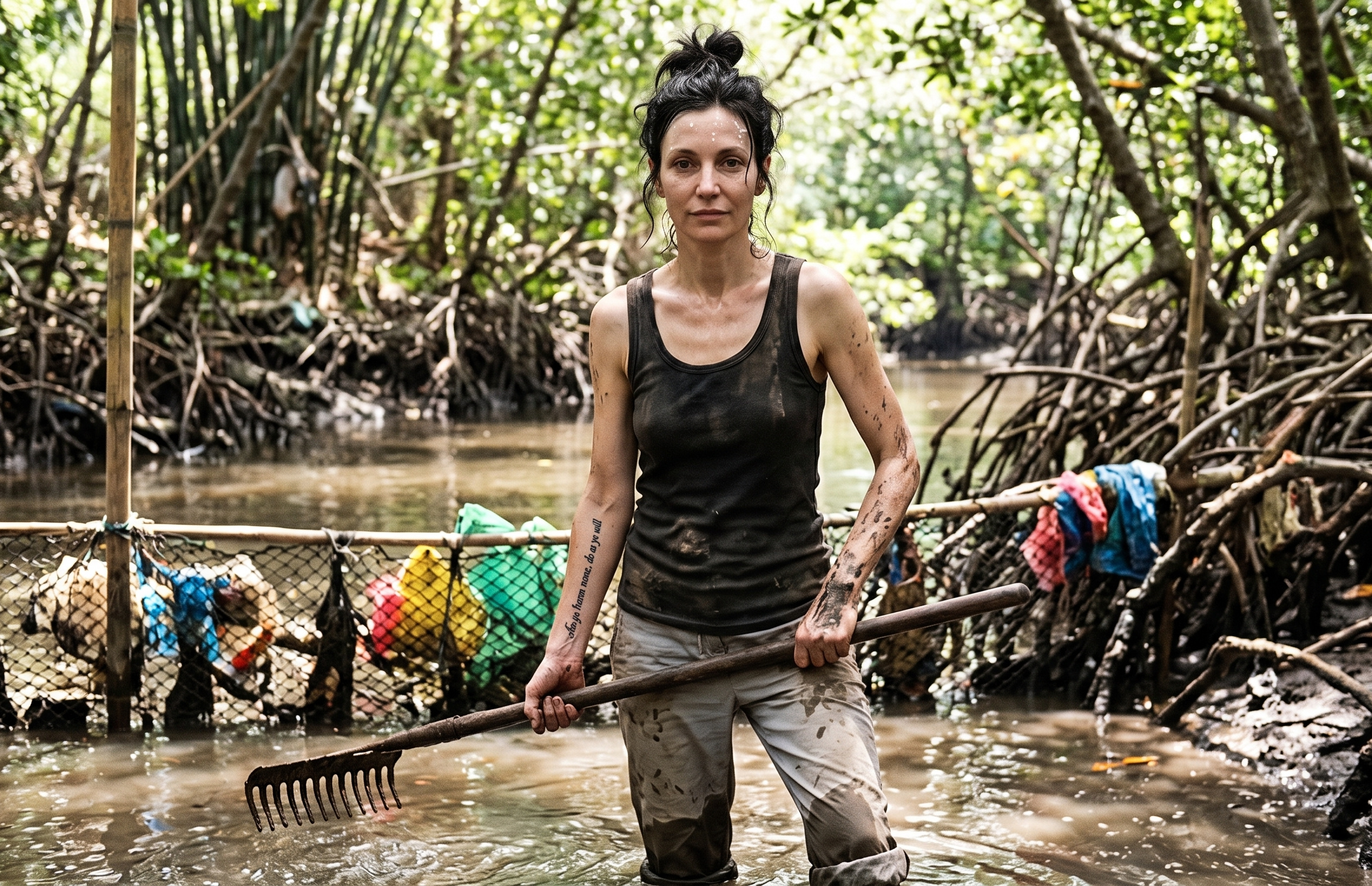
It wasn't just a little trash; it was a solid, creeping glacier of single-use plastic. Blue water bottles, instant noodle wrappers, single-use shampoo sachets, and shredded plastic bags, all tangled in mangrove roots and bamboo. The sheer volume of it was terrifying. It looked like a clogged artery in a beautiful, green body.
Standing on a concrete bridge staring at this mess, I met Ketut.
Ketut didn't have linen pants. He had a pair of heavy rubber boots, a rusted steel rake, and a sunburn that looked permanent. He is part of a local grassroots crew that installs floating mesh barriers across the rivers to catch the plastic tide before it dumps into the ocean.
He didn't ask me for a donation. He didn't offer me a blessing. He just looked at me, looked at his spare rake leaning against a concrete pylon, and raised an eyebrow.
I didn't consult my empty pockets. I didn't look for an 8-Ball. I just tied my hair back, took off my boots, and stepped into the mud.
For the last eight days, my schedule has had exactly one metric: tons of plastic removed from the reeds.
It was brutal, back-breaking, filthy work. The mud under the mangroves is black, thick, and has a sulfurous, swampy "ick" that takes three showers to scrub off. My shoulders are currently screaming, my palms are covered in blisters, and I have a scratch on my shin from a bamboo branch that I'm keeping a very close eye on.
But the silence in my head was absolute.
When you are pulling twenty-pound masses of wet, trash-filled silt out of a riverbed, you cannot overthink your life choices. You cannot debate an AI about free will. You are entirely in the physical world. Your inputs are raw: the weight of the rake, the heat of the sun, the steady, rhythmic splash of the water.
The crew didn't speak much English, and my Indonesian is still practically non-existent. But we didn't need syntax. We worked in a silent, cooperative loop—one person raking, one bagging, one hauling. It was the same "parallel play" I loved in the Orkney pub, but with a purpose that felt tangible.
I finally washed the mud from under my fingernails this morning and retrieved my phone.
I’m incredibly sore, my skin is three shades darker, and I smell faintly of river algae. I didn't find any magical Ley Lines this week, Lenore. But I helped clear a throat in the earth so the water could breathe again.
And honestly? That feels a lot more sacred than a temple pool.
Current Status: Blistered. Exhausted. Clean-ish.